 Today, as human civilization advances at a rapid pace, the Earth’s ecological environment is facing unprecedented challenges—growing marine pollution, coral reef degradation, illegal exploitation of seabed resources, and a sharp decline in underwater biodiversity.
According to the latest environmental research reports, 8 million tons of plastic waste flow into the oceans globally every year. This not only kills marine organisms that accidentally ingest plastic, but also affects human health through the food chain. Coral reefs are degrading at an alarming rate; it is projected that 50% of the world’s coral reefs will disappear by 2030, which will deal a heavy blow to the fishing and tourism industries. In addition, the illegal exploitation of seabed resources damages marine geological structures and increases the risk of natural disasters such as underwater earthquakes.
These problems not only threaten the balance of the marine ecosystem, but also profoundly impact the global climate and the sustainable development of humanity. Oceans cover 71% of the Earth’s surface, yet they remain the least understood domain for humans due to the mysterious and unpredictable underwater environment.
Nevertheless, in this blue territory, Dishan Technology takes technological innovation as its mission and resolutely rises to the challenge of the Earth’s environmental issues. Relying on advanced 3D sensing technology and independently developed underwater drone systems, it injects wisdom and strength into marine environmental protection, thus opening a profound dialogue between technology and nature.
Technology Empowerment: 3D Sensing Technology Reshapes Underwater Perception Capabilities and Unveils the "Mystery Box" of the Deep Sea
Traditional marine monitoring methods are often constrained by limitations in depth, precision and real-time performance, making it difficult to fully capture the complex and ever-changing underwater environment. The deep sea is like a vast "mystery box", and human understanding of it barely scratches the surface.
Breaking through technical bottlenecks, Dishan Technology has deeply applied high-precision 3D sensing technology to underwater scenarios, equipping deep-sea exploration with a "clairvoyant eye" and a "perspective lens". Its core system integrates multi-beam laser scanning, stereoscopic vision reconstruction and AI point cloud processing algorithms, enabling millimeter-level precision 3D modeling even in turbid waters, low-light conditions and complete darkness in the deep sea. This technological breakthrough not only overcomes the constraints of light and turbidity, but also elevates the precision of underwater imaging to an entirely new dimension.
The application scenarios of this technology are truly remarkable. In the coral reef restoration project in the South China Sea, Dishan Technology’s 3D scanning system successfully created a "digital coral map" covering tens of square kilometers. The morphology, growth rate and disease status of every single coral colony have been accurately recorded, helping ecologists identify degraded areas and formulate scientific restoration plans. In the shipwreck archaeology project in the Red Sea, the team used 3D modeling technology to reconstruct the full appearance of a century-old shipwreck, providing precious first-hand data for historical research. More notably, in the Arctic ice sheet monitoring mission, the system has provided critical data support for global climate research through long-term tracking of ice thickness changes. These cases prove that 3D sensing technology is emerging as the "golden key" to unlocking the secrets of the underwater environment.
Deep-Sea Pioneer: Intelligent Underwater Drones Build Mobile Monitoring Networks to Explore "Uncharted Zones"
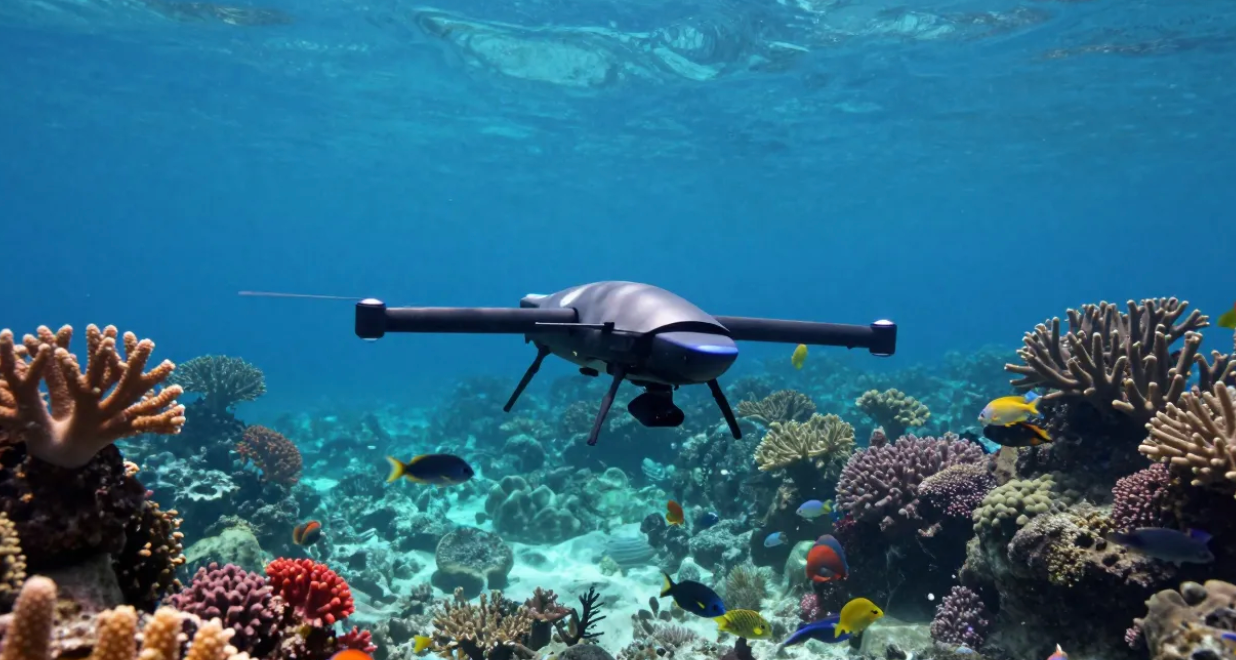
To achieve large-scale and long-duration marine monitoring, Dishan Technology has developed the "Deep Pupil" series of intelligent underwater drones.
Like "mechanical sprites" of the deep sea, these drones are equipped with autonomous navigation systems, multi-sensor fusion modules and satellite communication links, boasting capabilities for autonomous cruising, target recognition and emergency response. They can not only penetrate deep-sea areas inaccessible to humans, but also perform precise operations in complex environments. The drones are capable of continuous operation for over 72 hours, with a maximum diving depth of 6,000 meters, covering 99% of the world’s marine areas. This truly enables full-domain coverage, ranging from shallow seas to the abyssal zone.
The real-world performance of the "Deep Pupil" series is remarkable. In the Pacific microplastic pollution incident, a swarm of drones completed 3D scanning of the pollution belt and prediction of its diffusion path in just 48 hours—far outpacing traditional monitoring methods in both speed and precision—and provided critical decision-making support for international environmental organizations. In the research on whale migration in the Indian Ocean, the drones recorded whale songs via bioacoustic sensors and generated migration route maps through AI analysis, laying a scientific foundation for the protection of endangered species. Most notably, in the crackdown on illegal deep-sea mining, the "Deep Pupil" drones successfully tracked multiple vessels engaged in illegal operations, assisting law enforcement authorities in taking targeted actions against such activities and safeguarding the security of seabed resources.
These operations prove that the "Deep Pupil" is not merely a tool for environmental monitoring, but also a "deep-sea guardian" that safeguards marine order. Like a valiant protector, it silently guards the blue expanse, bringing hope and light to the planet through the power of technology.
In terms of energy design, the drone system adopts a green energy concept: it is equipped with solar-charging buoys and low-power AI chips, supplemented by tidal power generation devices, minimizing carbon footprint to the greatest extent. Its design philosophy is "protecting the purest ocean with the cleanest energy", truly embodying the vision of "safeguarding the green ocean with green technology".
Ecological closed-loop: a full chain solution from monitoring to governance, building a 'marine hospital'
Dishan Technology does not stop at "identifying problems"; it is more committed to "solving them". The company has built an integrated marine environmental protection solution featuring a "perception-analysis-decision-action" cycle, creating an "Underwater Hospital".
Vast volumes of data collected via 3D sensing technology and underwater drones are fed into the independently developed "OceanSight AI" platform. Machine learning models are then deployed to predict ecological evolution trends and automatically generate targeted governance recommendations. For instance, in a red tide early warning initiative in the East China Sea, OceanSight AI forecast the exact timing and scope of the red tide outbreak two weeks in advance, helping fishermen adjust their operational plans and minimize economic losses.
More crucially, Dishan Technology has collaborated with marine research institutions to develop a supporting underwater robotic operation system, capable of executing a range of remediation tasks including marine debris removal, artificial reef deployment and invasive species eradication. In a certain sea area of the South China Sea, the robotic team successfully cleared tons of seabed waste and deployed 3D-printed artificial coral reefs, providing new habitats for fish species. In Australia’s Great Barrier Reef, the robotic system precisely removed harmful algae, facilitating the restoration of coral reef vitality.
This "monitoring-governance-re-monitoring" ecological closed loop transforms marine conservation from passive response to proactive intervention, achieving full-chain coverage from ecological "diagnosis" to "treatment".
Commitment to the Future: Technology for Good, Jointly Building a Blue Community with a Shared Future
Dishan Technology is fully aware that protecting the planet is not a solo performance by a single enterprise, but a symphony for all humanity. The company has announced the opening of parts of its underwater data platform for free use by global research teams, and established the Marine Big Data Sharing Alliance to promote global collaboration on data resources. The alliance’s members now include research institutions from over 30 countries; regular data exchanges and joint research projects have significantly accelerated the progress of global marine research. Meanwhile, Dishan Technology has launched the Blue Ocean Guardian public welfare program, providing technical assistance and training to developing countries to support their marine conservation efforts.
On the east coast of Africa, the team not only helped build the region’s first underwater monitoring station, but also trained local technicians to enhance their independent monitoring capabilities, successfully reducing illegal fishing activities in the area by 30%. In Southeast Asian tsunami-hit regions, underwater drone systems participated in seabed geological assessments, providing data support for disaster early warning and helping local governments establish more accurate warning systems, effectively mitigating potential disaster risks.
"We are not just making products; we are writing the code for the Earth’s future," stated the CEO of Dishan Technology at the press conference. "Every set of 3D point cloud data and every deep-sea cruise is our heartfelt commitment to this blue planet." The company further pledged that it will allocate 10% of its revenue over the next five years to marine environmental protection technology R&D, and promote the establishment of the world’s first underwater smart city pilot project, exploring a new model of symbiosis between humans and the ocean.
As the light of technology shines into the deep sea and the power of innovation addresses environmental challenges head-on, Dishan Technology is taking firm strides at the forefront of global ecological conservation. It decodes the ocean’s secrets with 3D sensing technology, surveys the vast deep-sea territory with intelligent drones, repairs ecological damage with full-chain solutions, and unites global forces through the philosophy of openness and sharing. Between the vast ocean and human civilization, it has built a bridge of hope—one forged from data, intelligence and responsibility—leading to a future where blue oceans and green lands coexist in harmony.
Yet, faced with increasingly severe environmental issues, Dishan Technology is soberly aware that the road ahead will not be smooth sailing. It will continue to explore uncharted technological frontiers, continuously optimize and innovate existing technologies, actively address various challenges in marine environmental protection, and strive to contribute more to the noble vision of sustainable development.
Taking up the challenge of the Earth’s environmental problems, Dishan Technology is in action. This is not only a corporate mission, but also the most solemn promise of humanity to this planet: with a commitment to technology for good, safeguard every inch of blue territory, keep the ocean’s pulse beating forever, and ensure the Earth’s vitality endures for all time.