
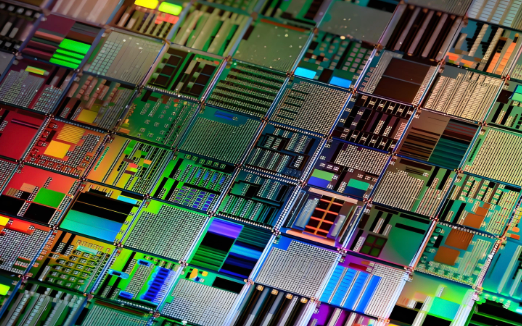
 In an era where the tide of technology surges forward relentlessly, chips are no longer merely the "brains" of electronic devices—they have evolved into the core engines propelling human civilization to new heights. From the seamless operation of smartphones and the intelligent decision-making of artificial intelligence, to the precise perception of autonomous driving and the future landscape of quantum computing, chips are omnipresent. Yet, they face numerous challenges in the relentless pursuit of ultimate performance, energy efficiency, integration, and intelligence.
The evolutionary history of chips is, in essence, an epic of constant breakthroughs in physical boundaries. From the micrometer scale to the nanometer scale, and now to the exploration of the angstrom scale, each step has entailed a redefinition of materials science, quantum effects, and manufacturing processes.
Dishan Technology is acutely aware that the first critical hurdle on the path to the "ultimate form" lies in challenging physical limits. The company has invested heavily in building ultra-clean laboratories and independently developed next-generation Enhanced Extreme Ultraviolet (EUV) Lithography technology. By optimizing light source wavelength, lens precision, and mask processes, it has doubled the lithography resolution compared to traditional technologies.
Simultaneously, Dishan has collaborated with top universities to explore the application of two-dimensional materials, carbon nanotubes, and topological insulators in transistors, aiming to break the performance bottlenecks of silicon-based materials. For instance, in the field of carbon nanotube transistors, the Dishan team successfully overcame the challenges of material purity and alignment uniformity, increasing transistor switching speed by 30% and reducing power consumption by 40%.
While the industry at large lingers at the 3nm and 2nm nodes, Dishan has quietly laid out plans for heterogeneous integration architectures below the 1nm mark. By stacking and combining chips of different materials and manufacturing processes to form three-dimensional heterogeneous structures, it achieves higher transistor density and lower interconnect latency per unit area.
This relentless exploration of the microcosm demands not only massive R&D investment but also extraordinary resilience and patience in the face of experimental failures. As the Chief Technology Officer of Dishan Technology put it: "Every nanoscale advancement is a dialogue with the laws of the quantum world. We must knock on the door of the unknown through tens of millions of experiments."
Challenging Architectural Paradigms: From "Computing Power Accumulation" to "Intelligent Synergy"
Today, as the demand for computing power grows exponentially, relying solely on process node scaling has become unsustainable. Dishan Technology recognizes that a true breakthrough must stem from a paradigm shift at the architectural level. Abandoning the traditional "general-purpose + accumulation" design philosophy, the company has instead built a new chip architecture characterized by heterogeneous integration, in-memory computing, and dynamic scheduling.
Its newly launched "Lingshu" series of AI chips features neuromorphic computing units working in synergy with traditional logic cores, enabling automatic switching of computing modes based on task types. For example, when processing natural language understanding tasks, the neuromorphic units simulate the connection mode of human brain neurons to achieve ultra-low-power parallel computing; when executing high-precision mathematical operations, the logic cores provide stable computing power support. This "dynamic adaptation" capability has led to an order-of-magnitude improvement in the chip’s energy efficiency ratio.
More notably, the "Lingshu" chip is equipped with a built-in intelligent scheduling system that can real-time monitor task loads and energy consumption status, optimizing resource allocation through algorithms. In autonomous driving scenarios, the chip can complete environmental perception, path planning, and decision control within milliseconds, while keeping power consumption at one-third that of traditional solutions. This is not only a technological innovation but also a philosophical response to the question of "how a chip should think".
From the very beginning of the architecture design, the Dishan Technology team put forward the concept of "enabling chips to learn to think about their own thinking". Through co-design of hardware and software, the chip is endowed with self-optimization capabilities. This courage to reconstruct underlying logic has transformed the chip from a passive computing tool into an active intelligent partner.
Innovation never happens in isolation. Faced with the realities of global supply chain volatility and escalating technological barriers, Dishan Technology rejects the approach of working behind closed doors.
The company launched the "Core Fire Alliance", uniting equipment manufacturers, material suppliers, and university research institutions to co-build an open-source chip platform. This initiative drives the implementation of the RISC-V ecosystem and lowers the barriers to innovation. Alliance members share R&D resources and jointly tackle key technologies. To date, they have successfully developed a variety of low-power IoT chips based on the RISC-V architecture, which are widely used in smart home, industrial control, and other fields.
More notably, Dishan has open-sourced some of its core IP to encourage global developers to participate in optimization. For example, the company’s open-source "Nebula" AI acceleration module has seen its inference speed in image recognition tasks increase by 50% after iterative improvements by developers worldwide, attracting over 100 enterprises to integrate it. This "anti-monopoly" open stance may seem risky, but it is in fact a profound interpretation of the spirit of "challenge"—true strength lies not in fearing sharing, but in amplifying the momentum of progress through collaboration.
Through ecosystem empowerment, Dishan is elevating "challenge" from a corporate initiative to an industry consensus. The company has also partnered with local governments to build chip innovation incubators, providing start-ups with full-chain support ranging from technical guidance to funding. Here, creative ideas are transformed into tangible products, fueling the vitality of the entire industry chain.
Behind the mantra of "constant challenge" lie countless trials, errors, and failures. A saying circulates within Dishan Technology: "For every successful chip tape-out, there are ninety-nine silent resets to zero."
The company has established a "Reverse Innovation Fund", dedicated to supporting high-risk, highly uncertain cutting-edge projects and allowing teams to "fail legally". For example, in a quantum tunneling experiment project, the team originally aimed to leverage quantum effects to boost transistor switching speed, but multiple experiments ended in failure. However, while analyzing the experimental data, they accidentally discovered a new type of low-leakage transistor structure. This structure was eventually applied in IoT chips, reducing standby power consumption by 90%. Such cases of "failure turning into opportunity" are common at Dishan.
It is precisely this cultural nurturing that empowers teams to dare to explore seemingly impossible technical paths. Each year, the company allocates 20% of its R&D investment to the Reverse Innovation Fund, supporting teams in challenging conventional wisdom. A photonics computing project that was originally rejected was restarted with the fund’s support, ultimately leading to the development of the first on-chip optical interconnection prototype—a breakthrough that is expected to solve the bandwidth bottleneck in internal chip data transmission.
Failure is no longer an endpoint but an incubator for new value—this is perhaps Dishan Technology’s most precious "secret to creation". Here, researchers no longer fear making mistakes; instead, they view every setback as an opportunity for cognitive upgrading, using the courage to challenge to turn "the impossible" into "the possible".
Challenge is the only path to the ultimate.
The "ultimate form" of chips may never truly be attained, yet it is this endless pursuit that defines the height of technological civilization. Dishan Technology has demonstrated through its actions that creating new value does not depend on the amount of resources one possesses, but on whether one retains the drive and perseverance to "keep challenging."
In the microcosm of physical limits, they push the boundaries of materials through countless experiments; in the reconstruction of architectural paradigms, they enable chips to "learn to think" with intelligent design; in the building of industrial ecosystems, they gather the power of innovation through openness and collaboration; in the subversion of self-perception, they nurture unexpected value from failures.
Today, Dishan Technology stands as a challenger, writing a future chapter for China’s chip industry— a chapter where there is no finish line, only boundaries that are constantly broken and new value that is continuously created. The future is already here, and the footsteps of the challengers will never stop.